Day 2: Old City and Kayaking
Today we begin our first full day in Dubrovnik.
The history of the city probably dates back to the 7th century, when the town known as Ragusa was founded by refugees from the Italian Peninsula. Between the 14th and 19th centuries, Dubrovnik ruled itself as a free state. The prosperity of the city was historically based on maritime trade. The country has found itself under many flags; it has been part of Italy during the Napoleonic Era, a province of France in the late 19th Century, part of the Kingdom of Dalmatia (part of the Austro-Hungarian Empire) in the early 20th Century, a puppet state of the Axis during WWII, before being reincorporated into Socialist Republic of Croatia in Socialist Federal Republic of Yugoslavia. In 1991 Croatia finally became independent, though it still had to fight an uphill battle during the “Homeland War” against the Serbs. In October of 1991, Dubrovnik was attacked, even though it had been declared a UNESCO site and there was no strategic value. Many buildings in the old city were damaged or destroyed by shelling (Bosnia is only about 5 miles away as the crow flies). After the war in 1995, reconstruction began and the old city is completely restored.

Mario picked us up in our luxurious Mercedes sprinter with plenty of room for the 8 of us to spread out. On board was Valentina, our guide for the morning. The plan was to visit the old town of Dubrovnik. Dubrovnik’s major claim to fame (at least for Americans) is that it was the site for filming much of Game of Thrones. Of our group, Molly was the only rabid GOT fan Jeri and I saw the first season and no one else had seen a single episode)..For those of you who are fans, many of the photos may be familiar.
At the west entrance to the old city, there is a fountain, the Jewish Fountain, which has been relocated from the “Jewish Street” (the ghetto). In the 1500s, about 250 Jews resettled in the area from Spain (escaping the Inquisition). They were received “with open arms” being primarily merchants and physicians and then promptly were given a small side street on which to live. It was gated on either end with the gates shut immediately at sunset. The fountain was given to the Jews primarily to keep them from poisoning the Christian wells.
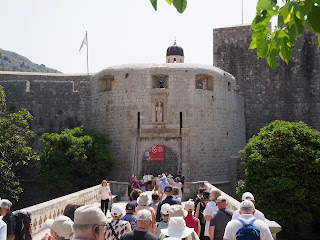

The main town fountain is found immediately upon entering through the west gate. The water from all the town fountains is potable, and we refilled our water bottles here. Though it was still early, the temperature was rapidly rising into the 80s with very blue skies and a strong sun.
Dubrovnik does not allow any sign on shops, so they use the lights instead.
 |
| Dubrovnik does not allow any sign on shops, so they use the lights instead.
|
As we walked through she streets of the old city, Valentina regaled us with stories about the city and the culture. We passed a jewelry shop with sets of distinctive earrings. She explained that young girls wear the small version, single, weddable women wear the mid-size version, and married women wear the large, HANDS OFF!
We stopped at the Green Market in the central square where we sampled (and bought) some locl delicacies, candied nuts and “fig salami” (just dried fig in salami shape).
These are the Croatian equivalent of the Spanish Steps in Rome designed by the same architect. According to the GOT aficionado, there is a famous scene, “the walk of shame”, where Queen Circe walks down the steps in the altogether.
We next had the opportunity to visit the Jewish Quarter.
Dubrovnik Synagogue is the oldest Sephardi Synagogue in the world and the second oldest Synagogue in Europe which is still in use today.. Dubrovnik Senate 1407 allowed Jews to settle in Dubrovnik. After 1492 and 1496 Jews were expelled from Spain and Portugal. Shepard Jews and Marranos came to Dubrovnik on Ragusan ships as the Republic’s ships visited Spain frequently or they stop on their way to the Ottoman Empire. Dubrovnik Synagogue was officially established 1546. Inner decoration in Baroque style was completed in 1652 and has been preserved to the present day.
In 1546, Dubrovnik officials allocated a Jewish settlement within the city, with the main street being called Ulica Žudioska ("Jewish Street") in the Dubrovnik Ghetto.


In 1546, Dubrovnik officials allocated a Jewish settlement within the city, with the main street being called Ulica Žudioska ("Jewish Street") in the Dubrovnik Ghetto.
The ghetto included houses with storage space and a synagogue and was administered by its elected head. The residents paid a special tax and had to be inside the ghetto during the night, when its gates were locked
When Dalmatia was occupied by Napoleonic forces, the Jews attained legal equality for the first time.[8] In 1814, when the Austrian Empire annexed Dalmatia, legal equality was again withdrawn. Jews were granted legal equality under Croatian law in the mid 19th century
During World War II, Dubrovnik came under fascist rule: the city was occupied first by the Italian army, and then by the German army after 8 September 1943. Before the Holocaust, 250 Jews lived in Dubrovnik; many were transferred to the island of Lopud along with other Jews from different parts of Croatia, then in June 1943 they were transferred to the Rab concentration camp with most Jews from Italian-occupied lands. In October 1944 Josip Broz Tito's Partisans entered Dubrovnik, and many Jews were transferred by the Partisans to the freed territories; the rest were sent by the Germans to concentration camps. After the war, many of the surviving Dubrovnik Jews settled in Israel. Today, approximately 30 Jews live in Dubrovnik; however, only 17 officially registered in the 2001 census. We were lucky to have one of the descendants of the original Jewish families from the 1400s to be our tour guide! She is single, so as of yet, no continuation of the lineage (although she was proposed to last week by a visitor to the syngogu. She said no :)).


We continued wandering the old town on our own and exited at the other end (not before a bit of gelato).
We then began a fairly long walk back to the hotel in the heat of the day.
When we got to the promenade, we decided to find lunch since it was approaching 3 pm. Our next activity was kayaking below the city walls until sunset, so we thought it best to have a decent meal. The Daves went6 for a swim in the Adriatic, I blogged (pretty rusty) and everyone else napped.
Then back off to the old city to meet our kayak guide, Ivan. After the required safety talk (and teaching us all how to paddle), we headed off. The conditions were perfect; not a cloud in the sky, warm enough for Jeri and Molly, and water like glass, only ripples were from boat traffic. We paddled from the old city around Lokrum Island visiting a couple of really cool caves on the way. On the return, we had absolutely gorgeous views of the setting sun. A truly magical end to a great first day of our trip.
When we got back to the hotel, Jeri and I decided to stay in while the rest of the crew went clubbing (actually went for Pizza, but didn’t get back until after 11-we were fat asleep by then).
Tomorrow we are off to neighboring Montenegro to visit the walked city of Kotor.